

[LINQ via C# series]
[Category Theory via C# series]
Latest version: https://weblogs.asp.net/dixin/category-theory-via-csharp-1-fundamentals
This post and the following posts will introduce category theory and its important concepts via C# and LINQ, including functor, applicative functor, monoid, monad, etc. Categories were first introduced by Samuel Eilenberg and Saunders Mac Lane in 1942–45. It might be tedious, as Wikipedia pointed:
A term dating from the 1940s, “general abstract nonsense”, refers to its high level of abstraction.
so these posts will have minimum theory, and a lot of C#/LINQ code to make some “specific intuitive sense”.
Category and category laws
A category C consists of:
- A collection of objects, denoted ob(C). This is not the objects in OOP.
- A collection of morphisms between objects, denoted hom(C).
- A morphism m from object A to object B is denoted m: X → Y:
- X is called source object.
- Y is called target object. To align to C# terms, Y will be called result object in these posts.
- A morphism m from object A to object B is denoted m: X → Y:
- Composition operation of morphisms, denoted ∘.

- For objects X,Y, Z, and morphisms m1: X → Y, m2: Y → Z, m1 and m2 can compose as m2 ∘ m1: X → Z.
- The name of m1 of m2 also implies the order. m2 ∘ m1 can be read as m2 after m1.

and satisfies 2 category laws:
- The ability to compose the morphisms associatively: For m1: W → X, m2: X → Y and m3: Y → Z, there is (m3 ∘ m2) ∘ m1 ≌ m3 ∘ (m2 ∘ m1).

- The existence of an identity morphism for each object: idx : X → X. For m: X → Y, there is idY ∘ m ≌ m ≌ m ∘ idX.

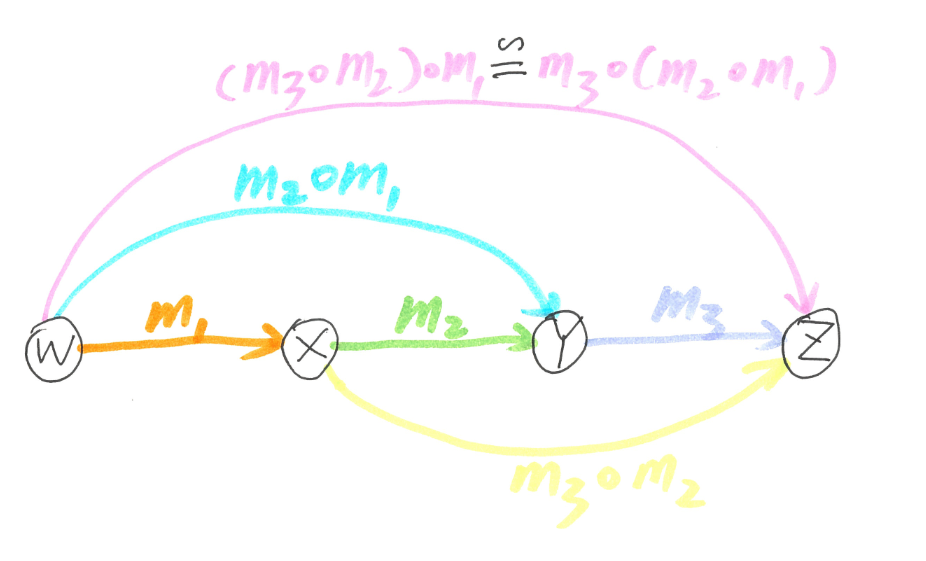

To make above general definitions more intuitive, category and its morphism can be represented by:
public interface ICategory<TCategory> where TCategory : ICategory<TCategory>{ // o = (m2, m1) -> composition [Pure] IMorphism<TSource, TResult, TCategory> o<TSource, TMiddle, TResult>( IMorphism<TMiddle, TResult, TCategory> m2, IMorphism<TSource, TMiddle, TCategory> m1);
[Pure] IMorphism<TObject, TObject, TCategory> Id<TObject>();}
public interface IMorphism<in TSource, out TResult, out TCategory> where TCategory : ICategory<TCategory>{ [Pure] TCategory Category { get; }
[Pure] TResult Invoke(TSource source);}For convenience, the composition function is uncurried with 2 arity. But this is no problem, because any function cannot curried or uncurried.
All members in above interfaces are tagged as [Pure] to indicate all their are all pure functions (C# property will be compiled to get/set functions too). The purity will be explained later.
The .NET category and morphism
Instead of general abstraction, in C#, the main category to play with is the .NET category:
- ob(DotNet) are .NET types, like int (System.Int32), bool (System.Boolean), etc.
- hom(DotNet) are C# pure functions, like f : int → bool, etc.
- Composition operation of morphisms is the composition of C# functions introduced in previous lambda calculus part.
Now it starts to make more sense:
public class DotNet : ICategory<DotNet>{ [Pure] public IMorphism<TObject, TObject, DotNet> Id<TObject> () => new DotNetMorphism<TObject, TObject>(@object => @object);
[Pure] public IMorphism<TSource, TResult, DotNet> o<TSource, TMiddle, TResult> (IMorphism<TMiddle, TResult, DotNet> m2, IMorphism<TSource, TMiddle, DotNet> m1) => new DotNetMorphism<TSource, TResult>(@object => m2.Invoke(m1.Invoke(@object)));
private DotNet() { }
public static DotNet Category {[Pure] get; } = new DotNet();}
public class DotNetMorphism<TSource, TResult> : IMorphism<TSource, TResult, DotNet>{ private readonly Func<TSource, TResult> function;
public DotNetMorphism(Func<TSource, TResult> function) { this.function = function; }
public DotNet Category { [Pure]get {return DotNet.Category;} }
[Pure] public TResult Invoke (TSource source) => this.function(source);}As expected, DotNetMorphism<TSource, TResult> become just a wrapper of Func<TSource, TResult> function.
And the DotNet category satisfies the category laws:

- The associativity of morphisms’ (C# functions’) composition is already proven before.
- The morphism returned by Id() is a wrapper of generic function (@object => @object), but it can be compiled to a copy for each closed type (each object ∈ ob(DotNet)), like Id
, Id (), id (), etc. (This is also called code explosion in .NET):