

[FP & LINQ via C# series]
[Category Theory via C# series]
Monoid and monoid laws
Monoid is an important algebraic structure in category theory. A monoid M is a set M equipped with a binary operation ⊙ and a special element I, denoted 3-tuple (M, ⊙, I), where
- M is a set of elements
- ⊙ is a binary operator called multiplication, so that M ⊙ M → M, which means the multiplication of 2 elements in set M always results an element in set M. This operation is also denoted μ, so that μ(M, M) ≡ M ⊙ M.
- I is a special unit element (aka neutral element, or identity element) in set M
And the binary operator and the unit element must satisfy the following monoid laws:
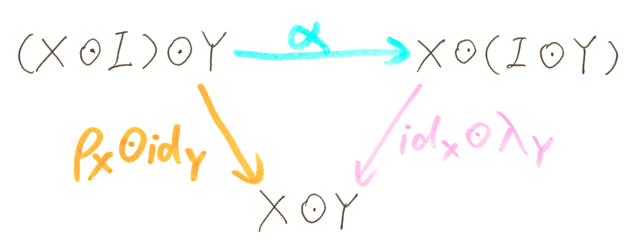
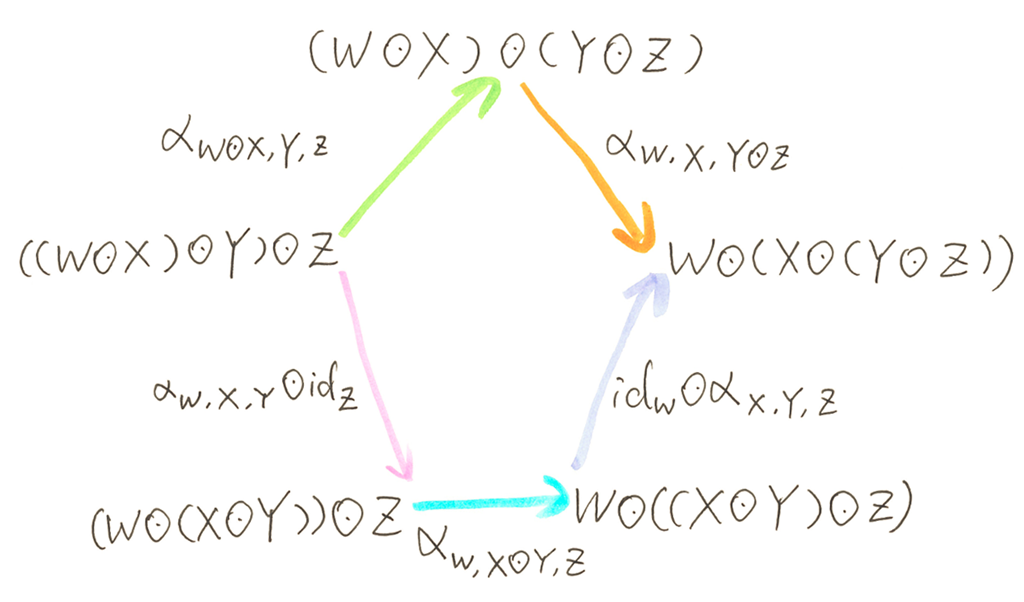
- associative law αX, Y, Z: (X ⊙ Y) ⊙ Z ≡ X ⊙ (Y ⊙ Z), where X ∈ M, Y ∈ M, Z ∈ M
- left unit law λX: I ⊙ X ≡ X, where X ∈ M; and right unit law ρX: X ≡ X ⊙ I, where X ∈ M
so that:
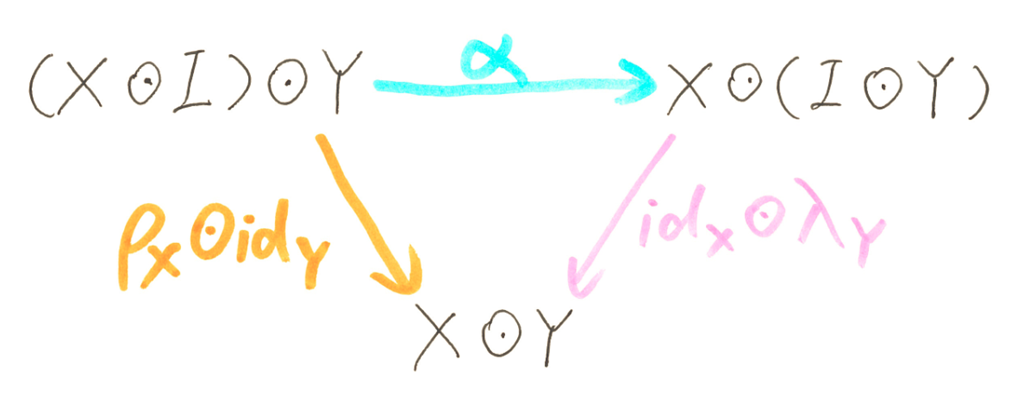
- the triangle identity commutes:
- and the pentagon identity commutes::

In C#, the monoid definition can be represented as:
public interface IMonoid<T>{ static abstract T Multiply(T value1, T value2);
static abstract T Unit { get; }}An intuitive example is the set ℤ of all integers, with binary operator + and unit element 0. The addition of 2 integers always results another integer; Also for integers x, y ,z, there is (x + y) + z ≡ x + (y + z) and 0 + x ≡ x ≡ x + 0 (ℤ, +, 0), so that (ℤ, +, 0) is monoid. Apparently (ℤ, *, 1) is monoid too.
public class Int32SumMonoid : IMonoid<int>{ public static int Multiply(int value1, int value2) => value1 + value2;
public static int Unit => GenericIndirection.AdditiveUnit<int>(); // 0.}
public class Int32ProductMonoid : IMonoid<int>{ public static int Multiply(int value1, int value2) => value1 * value2;
public static int Unit => GenericIndirection.MultiplicativeUnit<int>(); // 1.}
public static class GenericIndirection{ public static T AdditiveUnit<T>() where T : IAdditiveIdentity<T, T> => T.AdditiveIdentity;
public static T MultiplicativeUnit<T>() where T : IMultiplicativeIdentity<T, T> => T.MultiplicativeIdentity;}Another monoid example is (string, string.Concat, string.Empty):
public class StringConcatMonoid : IMonoid<string>{ public static string Multiply(string value1, string value2) => string.Concat(value1, value2);
public static string Unit => string.Empty;}Here string can be viewed as a sequence of char, and the unit string is an empty sequence. Generally, (IEnumerable
public class EnumerableConcatMonoid<T> : IMonoid<IEnumerable<T>>{ public static IEnumerable<T> Multiply(IEnumerable<T> value1, IEnumerable<T> value2) => value1.Concat(value2);
public static IEnumerable<T> Unit => Enumerable.Empty<T>();}The set of Boolean values { true, false }, with binary operator && and unit element true, is a monoid with only 2 element: ({true, false}, &&, true); And so is ({ true, false }, ||, false):
public class BooleanAndMonoid : IMonoid<bool>{ public static bool Multiply(bool value1, bool value2) => value1 && value2;
public static bool Unit => true;}
public class BooleanOrMonoid : IMonoid<bool>{ public static bool Multiply(bool value1, bool value2) => value1 || value2;
public static bool Unit => false;}A monoid with 1 single element can be defined with the special type void (System.Void):
namespace System{ [ComVisible(true)] [Serializable] [StructLayout(LayoutKind.Sequential, Size = 1)] public struct Void { }}The set { default(void) } with the following operator and unit is a monoid:
public class VoidMonoid : IMonoid<void>{ public void Multiply(void value1, void value2) => default;
public void Unit() => default;}However, C# compiler does not allow void keyword or System.Void type to be used in this way, so here System.Void can be replaced with its equivalency in F#, the Microsoft.FSharp.Core.Unit type:
namespace Microsoft.FSharp.Core{ [CompilationMapping(SourceConstructFlags.ObjectType)] [Serializable] public sealed class Unit : IComparable { internal Unit() { }
public override int GetHashCode() => 0;
public override bool Equals(object obj) => obj == null || LanguagePrimitives.IntrinsicFunctions.TypeTestGeneric<Unit>(obj);
int IComparable.CompareTo(object obj) => 0; }}With an internal constructor, Unit cannot be instantiated, a Unit variable can only be default(Unit), which is null. So similarly, set { default(Unit) } with the following operator and unit element is monoid:
public class UnitMonoid : IMonoid<Unit>{ public static Unit Multiply(Unit value1, Unit value2) => default;
public static Unit Unit => default;}Monoid as category
An individual monoid (M, ⊙, I) can be a category C with 1 single object M, where:
- The collection of objects ob(C) is { M }, which means, category C has 1 single object, that is M.
- The collection of orphisms hom(C) is set M itself, which mean, each elements in set M is a morphism in category C.
- The composition operation ∘ of C is ⊙: since each morphism in C is each element in M, the composition of morphisms is just the multiplication of elements.
- The identity morphism id of C is unit element I: the identity morphism in C is the unit element in M
In this way, since M, ⊙, I satisfies the monoid laws, apparently the category laws are satisfied. In C#, this singleton category can be represented as:
public class MonoidCategory<T, TMonoid> : ICategory<Type, T> where TMonoid : IMonoid<T>{ public static IEnumerable<Type> Objects { get { yield return typeof(TMonoid); } }
public static T Compose(T morphism2, T morphism1) => TMonoid.Multiply(morphism1, morphism2);
public static T Id(Type @object) => TMonoid.Unit;}