

[FP & LINQ via C# series]
[Category Theory via C# series]
Natural transformation and naturality
If F: C → D and G: C → D are both functors from categories C to category D, the mapping from F to G is called natural transformation and denoted α: F ⇒ G. α: F ⇒ G is actually family of morphisms from F to G, For each object X in category C, there is a specific morphism αX: F(X) → G(X) in category D, called the component of α at X. For each morphism m: X → Y in category C and 2 functors F: C → D, G: C → D, there is a naturality square in D:

In another word, for m: X → Y in category C, there must be αY ∘ F(m) ≡ G(m) ∘ αX , or equivalently αY ∘ SelectF(m) ≡ SelectG(m) ∘ αX in category D.
In DotNet category, the following ToLazy<> generic method transforms Func<> functor to Lazy<> functor:
public static partial class NaturalTransformations{ // ToLazy: Func<> -> Lazy<> public static Lazy<T> ToLazy<T>(this Func<T> function) => new Lazy<T>(function);}Apparently, for above natural transformation: ToLazy<>: Func<> ⇒ Lazy<>:
-
for each specific object T, there is an object Func
, an object Lazy , and a morphism ToFunc : Func → Lazy . -
For each specific morphism selector: TSource → TResult, there is a naturality square, which consists of 4 morphisms:
-
ToLazy
: Func → Lazy , which is the component of ToLazy<> at TResult -
FuncExtensions.Select(selector): Func
→ Func -
LazyExtensions.Select(selector): Lazy
→ Lazy -
ToLazy
: Func → Lazy , which is the component of ToLazy<> at TSource
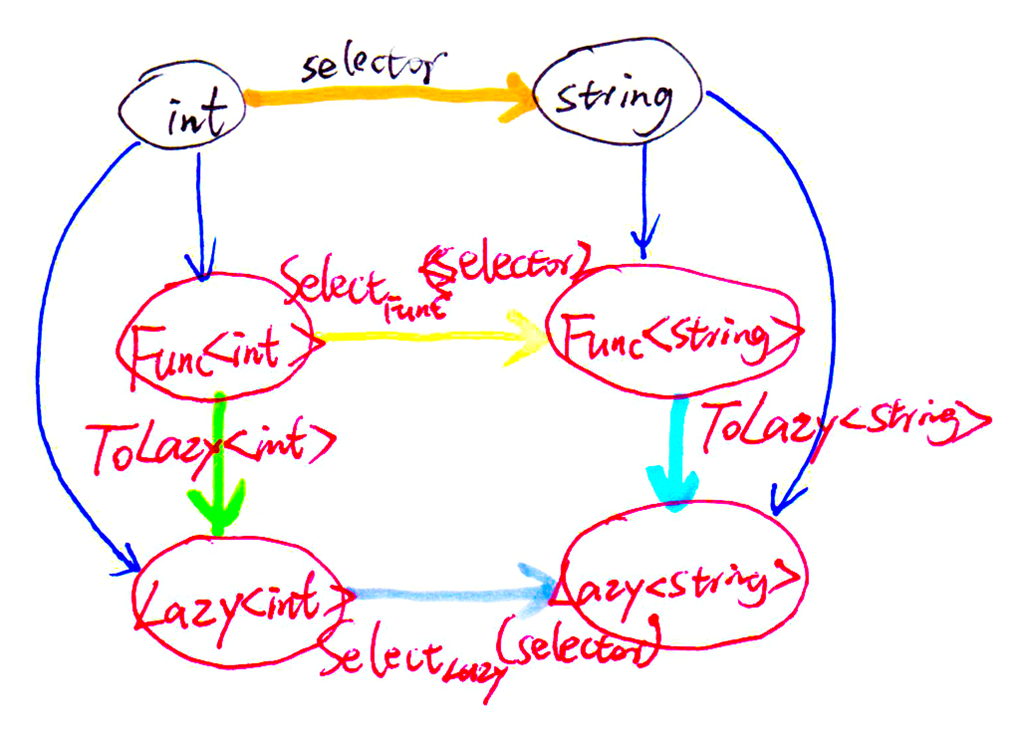
The following example is a simple naturality square that commutes for ToLazy<>:
internal static void Naturality(){ Func<int, string> selector = int32 => Math.Sqrt(int32).ToString("0.00");
// Naturality square: // ToFunc<string>.o(LazyExtensions.Select(selector)) == FuncExtensions.Select(selector).o(ToFunc<int>) Func<Func<string>, Lazy<string>> funcStringToLazyString = ToLazy<string>; Func<Func<int>, Func<string>> funcInt32ToFuncString = FuncExtensions.Select(selector); Func<Func<int>, Lazy<string>> leftComposition = funcStringToLazyString.o(funcInt32ToFuncString); Func<Lazy<int>, Lazy<string>> lazyInt32ToLazyString = LazyExtensions.Select(selector); Func<Func<int>, Lazy<int>> funcInt32ToLazyInt32 = ToLazy<int>; Func<Func<int>, Lazy<string>> rightComposition = lazyInt32ToLazyString.o(funcInt32ToLazyInt32);
Func<int> funcInt32 = () => 2; Lazy<string> lazyString = leftComposition(funcInt32); lazyString.Value.WriteLine(); // 1.41 lazyString = rightComposition(funcInt32); lazyString.Value.WriteLine(); // 1.41}And the following are a few more examples of natural transformations:
// ToFunc: Lazy<T> -> Func<T>public static Func<T> ToFunc<T>(this Lazy<T> lazy) => () => lazy.Value;
// ToEnumerable: Func<T> -> IEnumerable<T>public static IEnumerable<T> ToEnumerable<T>(this Func<T> function){ yield return function();}
// ToEnumerable: Lazy<T> -> IEnumerable<T>public static IEnumerable<T> ToEnumerable<T>(this Lazy<T> lazy){ yield return lazy.Value;}Functor Category
Now there are functors, and mappings between functors, which are natural transformations. Naturally, they lead to category of functors. Given 2 categories C and D, there is a functor category, denoted DC:
- Its objects ob(DC) are the functors from category C to D .
- Its morphisms hom(DC) are the natural transformations between those functors.
- The composition of natural transformations α: F ⇒ G and β: G ⇒ H, is natural transformations (β ∘ α): F ⇒ H.
- The identity natural transformation idF: F ⇒ F maps each functor to itself
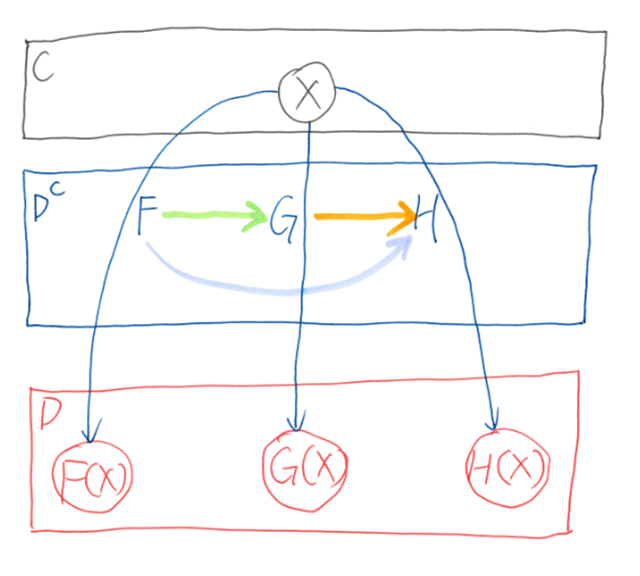
Regarding the category laws:
- Associativity law: As fore mentioned, natural transformation’s components are morphisms in D, so natural transformation composition in DC can be viewed as morphism composition in D: (β ∘ α)X: F(X) → H(X) = (βX: G(X) → H(X)) ∘ (αX: F(X) → G(X)). Natural transformations’ composition in DC is associative, since all component morphisms’ composition in D is associative
- Identity law: similarly, identity natural transform’s components are the id morphisms idF(X): F(X) → F(X) in D. Identity natural transform satisfy identity law, since all its components satisfy identity law.
Here is an example of natural transformations composition:
// ToFunc: Lazy<T> -> Func<T>public static Func<T> ToFunc<T>(this Lazy<T> lazy) => () => lazy.Value;#endif
// ToOptional: Func<T> -> Optional<T>public static Optional<T> ToOptional<T>(this Func<T> function) => new Optional<T>(() => (true, function()));
// ToOptional: Lazy<T> -> Optional<T>public static Optional<T> ToOptional<T>(this Lazy<T> lazy) => // new Func<Func<T>, Optional<T>>(ToOptional).o(new Func<Lazy<T>, Func<T>>(ToFunc))(lazy); lazy.ToFunc().ToOptional();}Endofunctor category
Given category C, there is a endofunctors category, denoted CC, or End(C), where the objects are the endofunctors from category C to C itself, and the morphisms are the natural transformations between those endofunctors.
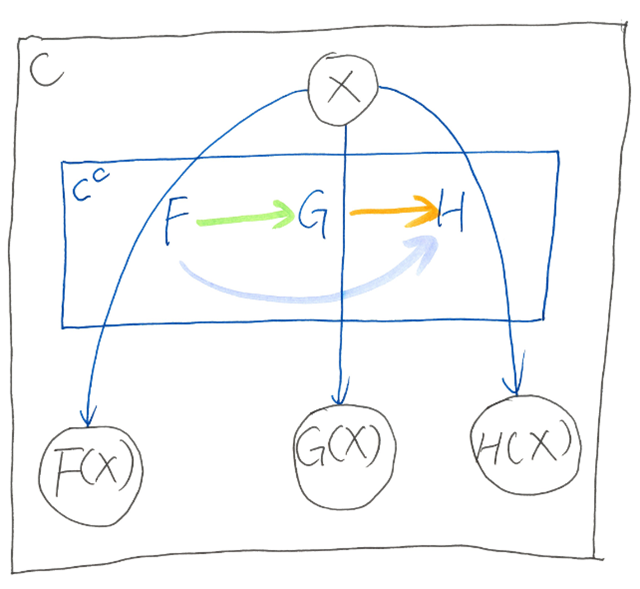
All the functors in C# are endofunctors from DotNet category to DotNet. They are the objects of endofunctor category DotNetDotNet or End(DotNet).