

[LINQ via C# series]
[Lambda Calculus via C# series]
Latest version: https://weblogs.asp.net/dixin/lambda-calculus-via-csharp-7-fixed-point-combinator-and-recursion
Fix point
p is the fixed point of function F if and only if:
p≡ F pThe following picture is stolen from Wikipedia:
#mediaviewer/File:Fixed_point_example.svg)

A simple example:
F := 0 - x
has a fixed point 0:
0≡ F 0The above fixed point definition also leads to:
p≡ F p≡ F (F p)≡ ...≡ F (F (F … (F p) …))Fixed point combinator
In lambda calculus and combinatory logic, Y combinator is a fixed point combinator:
Y := λf.(λx.f (x x)) (λx.f (x x))It is called so because it calculates a function F’s fixed point Y F.
According to the above definition of fixed point p ≡ F p, there is:
(Y F)≡ F (Y F)Proof:
Y F≡ (λf.(λx.f (x x)) (λx.f (x x))) F≡ (λx.F (x x)) (λx.F (x x))≡ F ((λx.F (x x)) (λx.F (x x)))≡ F (Y F)Y combinator was discovered by Haskell Curry.
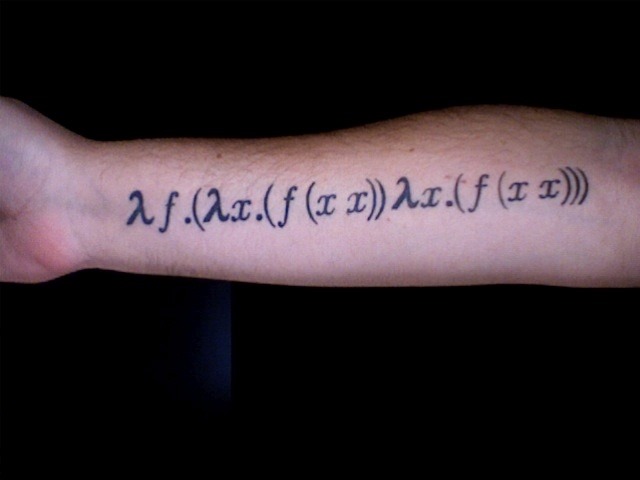
As a fixed point combinator, Y also has the same property of:
Y F≡ F (Y F)≡ F (F (Y F))≡ ...≡ F (F (F … (F (Y F)) …))So Y can be used to implement recursion.

And this is Y in SKI:
Y2 := S (K (S I I)) (S (S (K S) K) (K (S I I)))or just in SK:
Y3 := S S K (S (K (S S (S (S S K)))) K)And in C#:
public delegate Func<T, TResult> Recursion<T, TResult>(Recursion<T, TResult> f);
public static class YCombinator{ // Y = λf.(λx.f(x x)) (λx.f(x x)) // Y = f => (λx.f(x x)) (λx.f(x x)) // Y = f => (x => f(x(x)))(x => f(x(x))) // Y = (x => arg => f(x(x))(arg))(x => arg => f(x(x))(arg)) public static Func<T, TResult> Y<T, TResult> (Func<Func<T, TResult>, Func<T, TResult>> f) => new Recursion<T, TResult>(x => arg => f(x(x))(arg))(x => arg => f(x(x))(arg));}Recursion
As explaned in the part of Church numeral arithmetic, recursion cannot be implemented directly in lambda calculus.
Example - factorial
The factorial function can be intuitively implemented by recursion. In C#:
Func<uint, uint> factorial = null; // Must have. So that factorial can recursively refer itself.factorial = x => x == 0U ? 1U : factorial(x - 1U);But in lambda calculus:
λn.If (IsZero n) (λx.1) (λx.Self (Decrease n))An anonymous function cannot directly refer itself by its name in the body.
With Y, the solution is to create a helper to pass “the algorithm itself” as a parameter. So:
FactorialHelper := λf.λn.If (IsZero n) (λx.1) (λx.f (Decrease n))Now Y can be applied with the helper:
Y FactorialHelper nSo:
Factorial := Y FactorialHelper ≡ Y (λf.λn.If (IsZero n) (λx.1) (λx.f (Decrease n)))In C# lambda calculus:
public static partial class _NumeralExtensions{ // Factorial = factorial => numeral => If(numeral.IsZero())(_ => One)(_ => factorial(numeral.Decrease())); public static Func<_Numeral, _Numeral> Factorial (Func<_Numeral, _Numeral> factorial) => numeral => ChurchBoolean.If<_Numeral>(numeral.IsZero()) (_ => One) (_ => factorial(numeral.Decrease()));
public static _Numeral Factorial (this _Numeral numeral) => YCombinator.Y<_Numeral, _Numeral>(Factorial)(numeral);}Example - Fibonacci
Another recursion example is Fibonacci:
Func<uint, uint> fibonacci = null; // Must have. So that fibonacci can recursively refer itself.fibonacci = x => x > 1U ? fibonacci(x - 1U) + fibonacci(x - 2U) : x;The recursion cannot be done in anonymous function either:
λn.If (IsGreater n 1) (λx.Add (Self (Subtract n 1)) (Self (Subtract n 2))) (λx.n)The same solution can be used - create a helper to pass “the algorithm itself” as a parameter:
FibonacciHelper := λf.λn.If (IsGreater n 1) (λx.Add (f (Subtract n 1)) (f (Subtract n 2))) (λx.n)Application to Y will be the same way too:
Y FibonacciHelper nSo:
Fibonacci := Y FibonacciHelper ≡ Y (λf.λn.If (IsGreater n 1) (λx.Add (f (Subtract n 1)) (f (Subtract n 2))) (λx.n))C#:
public static partial class _NumeralExtensions{ // Fibonacci = fibonacci => numeral => If(numeral > One)(_ => fibonacci(numeral - One) + fibonacci(numeral - One - One))(_ => numeral); public static Func<_Numeral, _Numeral> Fibonacci (Func<_Numeral, _Numeral> fibonacci) => numeral => ChurchBoolean.If<_Numeral>(numeral > One) (_ => fibonacci(numeral - One) + fibonacci(numeral - One - One)) (_ => numeral);
public static _Numeral Fibonacci (this _Numeral numeral) => YCombinator.Y<_Numeral, _Numeral>(Fibonacci)(numeral);}DivideBy
In the Church numeral arithmetic, this (cheating) recursive _DivideBy was temporarily used:
_DivideBy := λa.λb.If (IsGreaterOrEqual a b) (λx.Add One (_DivideBy (Subtract a b) b)) (λx.Zero)Finally, with Y, a real DivideBy in lambda calculus can be defined:
DivideByHelper := λf.λa.λb.If (IsGreaterOrEqual a b) (λx.Add One (f (Subtract a b) b)) (λx.Zero)
DivideBy := Y DivideByHelper ≡ Y (λf.λa.λb.If (IsGreaterOrEqual a b) (λx.Add One (f (Subtract a b) b)) (λx.Zero))Once again, just create a helper to pass itself as a parameter to implement recursion, as easy as Factorial and Fibonacci.
C#:
public static partial class _NumeralExtensions{ // DivideBy = divideBy => dividend => divisor => If(dividend >= divisor)(_ => One + divideBy(dividend - divisor)(divisor))(_ => Zero) public static Func<_Numeral, Func<_Numeral, _Numeral>> DivideBy (Func<_Numeral, Func<_Numeral, _Numeral>> divideBy) => dividend => divisor => ChurchBoolean.If<_Numeral>(dividend >= divisor) (_ => One + divideBy(dividend - divisor)(divisor)) (_ => Zero);
public static _Numeral DivideBy (this _Numeral dividend, _Numeral divisor) => YCombinator.Y<_Numeral, Func<_Numeral, _Numeral>>(DivideBy)(dividend)(divisor);}Notice a difference here: Factorial and Fibonacci both takes 1 parameter, but DivideBy takes 2 parameters - dividend, divisor. However, with currying, Y<T, TResult> can just be closed type Y<X, Func<Y, Z>>, so that this difference is nicely and easily handled.
Unit tests
[TestClass()]public class _NumeralExtensionsTests{ [TestMethod()] public void FactorialTest() { Func<uint, uint> factorial = null; // Must have. So that factorial can recursively refer itself. factorial = x => x == 0U ? 1U : factorial(x - 1U);
Assert.IsTrue(factorial(0U) == 0U._Church().Factorial()); Assert.IsTrue(factorial(1U) == 1U._Church().Factorial()); Assert.IsTrue(factorial(2U) == 2U._Church().Factorial()); Assert.IsTrue(factorial(3U) == 3U._Church().Factorial()); Assert.IsTrue(factorial(10U) == 10U._Church().Factorial()); }
[TestMethod()] public void FibonacciTest() { Func<uint, uint> fibonacci = null; // Must have. So that fibonacci can recursively refer itself. fibonacci = x => x > 1U ? fibonacci(x - 1U) + fibonacci(x - 2U) : x;
Assert.IsTrue(fibonacci(0U) == 0U._Church().Fibonacci()); Assert.IsTrue(fibonacci(1U) == 1U._Church().Fibonacci()); Assert.IsTrue(fibonacci(2U) == 2U._Church().Fibonacci()); Assert.IsTrue(fibonacci(3U) == 3U._Church().Fibonacci()); Assert.IsTrue(fibonacci(10U) == 10U._Church().Fibonacci()); }
[TestMethod()] public void DivideByTest() { Assert.IsTrue(1U / 1U == (1U._Church().DivideBy(1U._Church()))); Assert.IsTrue(1U / 2U == (1U._Church().DivideBy(2U._Church()))); Assert.IsTrue(2U / 2U == (2U._Church().DivideBy(2U._Church()))); Assert.IsTrue(2U / 1U == (2U._Church().DivideBy(1U._Church()))); Assert.IsTrue(10U / 3U == (10U._Church().DivideBy(3U._Church()))); Assert.IsTrue(3U / 10U == (3U._Church().DivideBy(10U._Church()))); }}