

So far LINQ to SQL data CRUD (Creating / Retrieving / Updating / Deleting) has been explained. This post takes a deeper look at the internal implementation of LINQ to SQL query.
The provider model
Unlike IEnumerable / IEnumerable
namespace System.Linq{ public interface IQueryable : IEnumerable { Type ElementType { get; }
Expression Expression { get; }
IQueryProvider Provider { get; } }
public interface IQueryable<out T> : IEnumerable<T>, IQueryable, IEnumerable { }}And this is the definition of IQueryProvider:
namespace System.Linq{ public interface IQueryProvider { IQueryable CreateQuery(Expression expression);
IQueryable<TElement> CreateQuery<TElement>(Expression expression);
object Execute(Expression expression);
TResult Execute<TResult>(Expression expression); }}Yes, IQueryable / IQueryable
Please also notice IOrderedQueryable and IOrderedQueryable
namespace System.Linq{ // The same as IQueryable. public interface IOrderedQueryable : IQueryable, IEnumerable { }
// The same as IQueryable<T>. public interface IOrderedQueryable<out T> : IOrderedQueryable, IQueryable<T>, IQueryable, IEnumerable<T>, IEnumerable { }}They are the same as IQueryable and IQueryable
Implement IQueryable and IOrderedQueryable
The best way to understand these interfaces is just creating IQueryable / IQueryable
This is one simple implementation:
public class Queryable<TSource> : IOrderedQueryable<TSource>{ public Queryable(IQueryProvider provider, IQueryable<TSource> innerSource) { this.Provider = provider; this.Expression = Expression.Constant(innerSource); }
public Queryable(IQueryProvider provider, Expression expression) { this.Provider = provider; this.Expression = expression; }
#region IEnumerable<TSource> Members
public IEnumerator<TSource> GetEnumerator() { return this.Provider.Execute<IEnumerable<TSource>>(this.Expression).GetEnumerator(); }
#endregion
#region IEnumerable Members
IEnumerator IEnumerable.GetEnumerator() { return this.GetEnumerator(); }
#endregion
#region IQueryable Members
public Type ElementType { get { return typeof(TSource); } }
public Expression Expression { get; private set; }
public IQueryProvider Provider { get; private set; }
#endregion}Since Queryable
There is not too much things. The most important method is GetEnumerator(). When a Queryable
Implement IQueryProvider
So the actual SQL query implantation is in the query provider:
public class QueryProvider : IQueryProvider{ // Translates LINQ query to SQL. private readonly Func<IQueryable, DbCommand> _translator;
// Executes the translated SQL and retrieves results. private readonly Func<Type, string, object[], IEnumerable> _executor;
public QueryProvider( Func<IQueryable, DbCommand> translator, Func<Type, string, object[], IEnumerable> executor) { this._translator = translator; this._executor = executor; }
#region IQueryProvider Members
public IQueryable<TElement> CreateQuery<TElement>(Expression expression) { return new Queryable<TElement>(this, expression); }
public IQueryable CreateQuery(Expression expression) { throw new NotImplementedException(); }
public TResult Execute<TResult>(Expression expression) { bool isCollection = typeof(TResult).IsGenericType && typeof(TResult).GetGenericTypeDefinition() == typeof(IEnumerable<>); Type itemType = isCollection // TResult is an IEnumerable`1 collection. ? typeof(TResult).GetGenericArguments().Single() // TResult is not an IEnumerable`1 collection, but a single item. : typeof(TResult); IQueryable queryable = Activator.CreateInstance( typeof(Queryable<>).MakeGenericType(itemType), this, expression) as IQueryable;
IEnumerable queryResult;
// Translates LINQ query to SQL. using (DbCommand command = this._translator(queryable)) { // Executes the transalted SQL. queryResult = this._executor( itemType, command.CommandText, command.Parameters.OfType<DbParameter>() .Select(parameter => parameter.Value) .ToArray()); }
return isCollection ? (TResult)queryResult // Returns an IEnumerable`1 collection. : queryResult.OfType<TResult>() .SingleOrDefault(); // Returns a single item. }
public object Execute(Expression expression) { throw new NotImplementedException(); }
#endregion}QueryProvider must be initialized with a translator and executor, so that it is able to translate LINQ query to SQL, and execute the translated SQL.
And here the most important is the generic Execute() method, which is called by the above Queryable
- Checks whether it should return a collection of items (for the Where() scenarios, etc.), or should return a sinlge item (for the Single() query scenarios, etc.)
- Invokes the translator to translate LINQ query to SQL.
- Invokes the executor to execute the translated SQL and retrieves the result.
- Returns result of a proper type (either a collection, or a single item).
Query method internals
Before running the query, take a look at the IQueryable
Deferred execution methods
Take Where() as an example:
public static class Queryable{ public static IQueryable<TSource> Where<TSource>( this IQueryable<TSource> source, Expression<Func<TSource, bool>> predicate) { // Checks arguments. return source.Provider.CreateQuery<TSource>( Expression.Call( null, ((MethodInfo)MethodBase.GetCurrentMethod()).MakeGenericMethod(new Type[] { typeof(TSource) }), new Expression[] { source.Expression, Expression.Quote(predicate) })); }}It is very very different from IEnumerable
- Constructs a new expression tree, which contains the following information:
- The original expression tree from the source IQueryable
object - The predicate expression tree
- This Where() query method is invoked
- The original expression tree from the source IQueryable
- Then invokes the query provider’s generic CreateQuery() method to construct a new IQueryable
object.
Obviously, the above constructed expression tree is used to contain the information which is prepared to be translated.
The ordering query method, like OrderBy(), is a little different, which converts the constructed IQueryable
public static IOrderedQueryable<TSource> OrderBy<TSource, TKey>( this IQueryable<TSource> source, Expression<Func<TSource, TKey>> keySelector){ // Checks arguments. return (IOrderedQueryable<TSource>)source.Provider.CreateQuery<TSource>( Expression.Call( null, ((MethodInfo)MethodBase.GetCurrentMethod()).MakeGenericMethod(new Type[] { typeof(TSource), typeof(TKey) }), new Expression[] { source.Expression, Expression.Quote(keySelector) }));}And so is ThenBy():
public static IOrderedQueryable<TSource> ThenBy<TSource, TKey>( this IOrderedQueryable<TSource> source, Expression<Func<TSource, TKey>> keySelector){ // Checks arguments. return (IOrderedQueryable<TSource>)source.Provider.CreateQuery<TSource>( Expression.Call( null, ((MethodInfo)MethodBase.GetCurrentMethod()).MakeGenericMethod(new Type[] { typeof(TSource), typeof(TKey) }), new Expression[] { source.Expression, Expression.Quote(keySelector) }));}ThenBy() / ThenByDescending() are extension methods of IOrderedQueryable
Eager execution methods
Single() is different:
public static TSource Single<TSource>(this IQueryable<TSource> source){ // Checks arguments. return source.Provider.Execute<TSource>( Expression.Call( null, ((MethodInfo)MethodBase.GetCurrentMethod()).MakeGenericMethod(new Type[] { typeof(TSource) }), new Expression[] { source.Expression }));}Logically, Single() cannot be deferred. So after construction the expression tree, it invokes query provider’s generic Execute() method, and returns a TSource object instead of a IQueryable
Of course, the aggregate methods looks similar, invoking Execute() instead of CreateQuery():
public static decimal Average<TSource>( this IQueryable<TSource> source, Expression<Func<TSource, decimal>> selector){ // Checks arguments. return source.Provider.Execute<decimal>( Expression.Call( null, ((MethodInfo)MethodBase.GetCurrentMethod()).MakeGenericMethod(new Type[] { typeof(TSource) }), new Expression[] { source.Expression, Expression.Quote(selector) }));}It cannot be deferred either.
Work together
Now it is ready to run all the stuff above.
Query a collection of items (deferred execution)
The following query expects a collection of Product objects:
using (NorthwindDataContext database = new NorthwindDataContext()){ IQueryProvider provider = new QueryProvider(database.GetCommand, database.ExecuteQuery); IQueryable<Product> source = new Queryable<Product>(provider, database.GetTable<Product>()); IQueryable<string> results = source.Where(product => product.CategoryID == 2) .OrderBy(product => product.ProductName) .Select(product => product.ProductName) .Skip(5) .Take(10);
using (IEnumerator<string> iterator = results.GetEnumerator()) { while (iterator.MoveNext()) { string item = iterator.Current; Console.WriteLine(item); } }}To initialize the provider, DataContext.GetCommand() and DataContext.ExecuteQuery() are passed as translator and executor.
When results.GetEnumerator() is invoked, provider.Execute() is invoked. The query is translated to:
exec sp_executesql N'SELECT [t1].[ProductName]FROM ( SELECT ROW_NUMBER() OVER (ORDER BY [t0].[ProductName]) AS [ROW_NUMBER], [t0].[ProductName] FROM [dbo].[Products] AS [t0] WHERE [t0].[CategoryID] > @p0 ) AS [t1]WHERE [t1].[ROW_NUMBER] BETWEEN @p1 + 1 AND @p1 + @p2ORDER BY [t1].[ROW_NUMBER]',N'@p0 int,@p1 int,@p2 int',@p0=2,@p1=5,@p2=10by the provider’s translator, then provider’s executor executes the above SQL in SQL Server, and return a collection of items.
This is the printed output:
Escargots de Bourgogne Filo Mix Flotemysost Geitost Gnocchi di nonna Alice Gorgonzola Telino Gravad lax Gudbrandsdalsost Gumbär Gummibärchen Gustaf’s Knäckebröd
Query a single item (eager execution)
The following sample is different:
IQueryProvider provider = new QueryProvider(database.GetCommand, database.ExecuteQuery);IQueryable<Product> source = new Queryable<Product>(provider, database.GetTable<Product>());string productName = source.Where(product => product.CategoryID > 2) .Select(product => product.ProductName) .First();Without deferred execution and iterating, the First() invokes provider.Execute() directly.
This is the translated SQL:
exec sp_executesql N'SELECT TOP (1) [t0].[ProductName]FROM [dbo].[Products] AS [t0]WHERE [t0].[CategoryID] > @p0',N'@p0 int',@p0=2Aggregate (eager execution)
Aggregate query is also eager:
IQueryProvider provider = new QueryProvider(database.GetCommand, database.ExecuteQuery);IQueryable<Product> source = new Queryable<Product>(provider, database.GetTable<Product>());decimal averagePrice = source.Where(product => product.CategoryID == 2) .Average(product => product.UnitPrice.GetValueOrDefault());This is the translated SQL:
exec sp_executesql N'SELECT AVG([t1].[value]) AS [value]FROM ( SELECT COALESCE([t0].[UnitPrice],0) AS [value], [t0].[CategoryID] FROM [dbo].[Products] AS [t0] ) AS [t1]WHERE [t1].[CategoryID] = @p0',N'@p0 int',@p0=2SQL translating and executing
The above samples explained the implementation of LINQ to SQL query and query provider. Inside the QueryProvider class, it does not provide the detailed implementation of SQL translating and executing, but pass the work to DataContext.GetCommand() and DataContext.ExecuteQuery().
This post has demonstrated the simplest SQL translating and executing. But the realistic work is very very complex. Since this is not a SQL series but a LINQ / functional programming series, to develop a full featured SQL “compiler” is far beyond this series’ scope. For SQL executing, it is also complex to convert the retrieved data back to strong-typed objects in LINQ to SQL. To understand the entire translating and executing process, please follow the source code of Table
Internally, Table
internal class QueryConverter{ private SqlNode VisitSequenceOperatorCall(MethodCallExpression mc) { Type declaringType = mc.Method.DeclaringType; if (!(declaringType == typeof(Enumerable)) && !(declaringType == typeof(Queryable))) { throw new InvalidOperationException(string.Format( CultureInfo.InvariantCulture, "Sequence operator call is only valid for Sequence, Queryable, or DataQueryExtensions not for '{0}'", declaringType)); }
bool isNotSupported = false; switch (mc.Method.Name) { case "Where": isNotSupported = true;
// The overload: // IQueryable<TSource> Where<TSource>( // this IQueryable<TSource> source, Expression<Func<TSource, int, bool>> predicate) // is not supported.
// The MethodCallExpression object mc should have 2 arguments. // The first argument should be null. // The second argument should be Expression.Quote(predicate). if (mc.Arguments.Count != 2 || // IsLambda() removes the quote to get the predicate object, // and checks predicate.NodeType == ExpressionType.Lambda. !this.IsLambda(mc.Arguments[1]) || // precicate should have 1 TSource argument. this.GetLambda(mc.Arguments[1]).Parameters.Count != 1) { break; // The overload is not supported. }
// The overload: // IQueryable<TSource> Where<TSource>( // this IQueryable<TSource> source, Expression<Func<TSource, bool>> predicate) // is supported. return this.VisitWhere(mc.Arguments[0], this.GetLambda(mc.Arguments[1]));
case "OrderBy": isNotSupported = true;
if (mc.Arguments.Count != 2 || !this.IsLambda(mc.Arguments[1]) || this.GetLambda(mc.Arguments[1]).Parameters.Count != 1) { break; // The overload is not supported. }
return this.VisitOrderBy( mc.Arguments[0], this.GetLambda(mc.Arguments[1]), SqlOrderType.Ascending);
case "ThenBy": isNotSupported = true;
if (mc.Arguments.Count != 2 || !this.IsLambda(mc.Arguments[1]) || this.GetLambda(mc.Arguments[1]).Parameters.Count != 1) { break; // The overload is not supported. }
return this.VisitThenBy( mc.Arguments[0], this.GetLambda(mc.Arguments[1]), SqlOrderType.Ascending);
case "Single": case "SingleOrDefault": isNotSupported = true;
if (mc.Arguments.Count != 1) { if (mc.Arguments.Count != 2 || !this.IsLambda(mc.Arguments[1]) || this.GetLambda(mc.Arguments[1]).Parameters.Count != 1) { break; // The overload is not supported. }
return this.VisitFirst( mc.Arguments[0], this.GetLambda(mc.Arguments[1]), false); }
return this.VisitFirst(mc.Arguments[0], null, false);
case "Average": isNotSupported = true;
if (mc.Arguments.Count != 1) { if (mc.Arguments.Count != 2 || !this.IsLambda(mc.Arguments[1]) || this.GetLambda(mc.Arguments[1]).Parameters.Count != 1) { break; // The overload is not supported. }
return this.VisitAggregate( mc.Arguments[0], this.GetLambda(mc.Arguments[1]), SqlNodeType.Avg, mc.Type); }
return this.VisitAggregate(mc.Arguments[0], null, SqlNodeType.Avg, mc.Type);
// Other cases, like "Take", "Skip", "Distinct", etc. }
if (isNotSupported) { throw new NotSupportedException(string.Format( CultureInfo.InvariantCulture, "Unsupported overload used for query operator '{0}'.", mc.Method.Name)); }
throw new NotSupportedException(string.Format( CultureInfo.InvariantCulture, "The query operator '{0}' is not supported.", mc.Method.Name)); }}Please compare this with the fore mentioned IQueryable
There is also an excellent tutorial from MSDN.
LINQ Providers
There are several kinds of built-in LINQ in .NET 4.0:
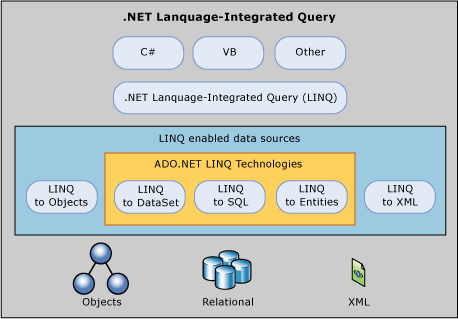
Built-in IQueryable LINQ Providers
LINQ to Objects and LINQ to XML are IEnumerable based, and the 3 kinds of LINQ to ADO.NET are IQueryable-based, which have their specific IQueryProvider.
For example, in LINQ to SQL, the IQueryable, IQueryable
LINQ to Everything
To implement any other LINQ query against a specific data source, the specific LINQ provider should be provided. That is, classes which implements the above IQueryable, IQueryable
etc.
This tutorial teaches how to create a IQueryable LINQ provider against the TerraServer-USA Web service.
LINQ to Objects provider
LINQ to Objects is IEnumerable based, but the interesting thing is, IEnumerble
public static class Queryable{ public static IQueryable<TElement> AsQueryable<TElement>( this IEnumerable<TElement> source) { // Checks arguments. if (source is IQueryable<TElement>) { return (IQueryable<TElement>)source; }
return new EnumerableQuery<TElement>(source); }}Here the EnumerableQuery
namespace System.Linq{ public abstract class EnumerableQuery { // ... }
public class EnumerableQuery<T> : EnumerableQuery, IQueryProvider, IQueryable<T>, IQueryable, IOrderedQueryable<T>, IOrderedQueryable, IEnumerable<T>, IEnumerable { // ... }}Internally, EnumerableQuery